
Some links in this story are affiliate links. If you book through them, I may earn a small commission at no extra cost to you. It's one of the ways Wandering Emerald stays independent. Read the full disclosure.
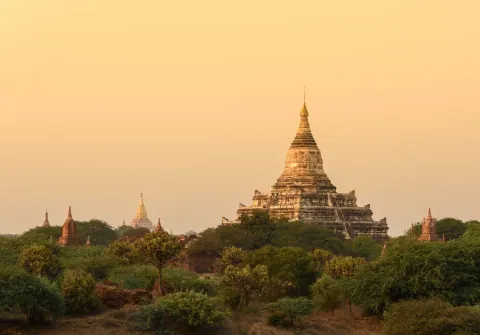
The sun was going down over Bagan, and I didn’t want to move.
From a small hill at the edge of the ancient plain, I could see hundreds of pagodas and temples spreading in every direction: red-brick stupas rising from the dust, catching the last of the light. Some were crumbling. Some were gilded. All of them had been standing there for nearly a thousand years. I don’t know exactly what I felt in that moment. Ecstatic, maybe. Emotional, definitely. Like I had wandered into a place I had no right to be this lucky to see.
I waved goodbye to Bagan from that hill. I know how that sounds. But it felt like the only honest thing to do.
Myanmar had been doing that to me for weeks. Giving me moments of pure, overwhelming beauty, and then quietly sitting me down with its reality.
I visited in October and November 2025. Traveling to Myanmar means traveling under a military junta that has been in power since the 2021 coup, through a country still absorbing the shock of a devastating earthquake earlier that year, in a tourism industry running at a fraction of what it once was. I knew some of that before I went. You can’t really know all of it until you’re there.
In Yangon, I stood at the base of Shwedagon Pagoda and looked up. The stupa rises nearly a hundred meters above the city, and its surface is layered in gold plates, real gold, donated by devotees over centuries. At the very top: diamonds, rubies, sapphires, and other precious stones. In the right light, the whole thing glows. A guide told me the pagoda is believed to enshrine eight hairs of the historical Buddha, making it the holiest Buddhist site in Myanmar. Standing in front of it, you understand quickly why the Burmese hold it the way they do. It is not just a monument. It is where they go to believe in something.
Shwedagon is now my favorite pagoda anywhere I’ve been. That might sound like a strong claim. I’m keeping it.
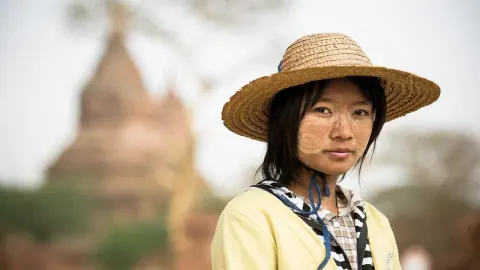
My guide in Bagan was a woman named Nway. She is also a fashion designer: she makes her own clothes, sews them herself, carries herself with a kind of quiet, deliberate elegance. On the last day of my visit, she handed me a tote bag she had made specifically for me.
I’ve received gifts while traveling before. This one is different. Not because of what it is, but because of what I know it cost her: not in money, but in time and intention, from someone who has very little of either to spare.
Nway told me she hasn’t seen her family in years. Her village is near one of the conflict zones. Her sister, in her sixties, was taken by armed forces along with other village elders. No one knows if she’s still alive.
Before the coup, Nway was fully booked. Tourism was rebuilding, and Bagan was drawing visitors again. Now she gets one client a month, if she’s lucky. She wakes up anyway, puts on her thanaka, and shows up.
I kept waiting for her to ask me for something. She never did. She just gave.
In Yangon, I spent time with Aung, who has worked in tourism since 2003. He has watched his country through the 2007 Saffron Revolution, the brief democratic opening under Aung San Suu Kyi, and now this. That’s over two decades of loving a place and watching it suffer.
I asked him what he was most proud of as a Burmese person.
He said: “None.”
Then, after a pause: “We used to be proud. Now we just survive.”
I didn’t have anything to say to that. So I just listened.
This is part of what makes Myanmar so hard to sit with. The country is extraordinarily rich in rubies, jade, gold, natural gas, and oil. It has everything the earth can offer. Very little of that wealth has ever reached the people who live on top of it. Nway told me that many people in rural areas earn less than two dollars a day. Meanwhile, the junta controls the resource flows, the borders, and access to information. Internet access and social media are heavily restricted. Brownouts are a daily fact of life.
And somehow, the people still offer you tea.
I’ve thought about what it means to travel somewhere like this. Whether tourism helps or simply turns suffering into a backdrop. I don’t have a clean answer, and I’m not sure anyone does. What I know is that when you go with your eyes open, you come home carrying something that doesn’t go away. Not a lesson, exactly. More like a responsibility. The kind that asks you to pay attention, and to say something true when you get back.
Nway’s tote bag is sitting in my room right now. I look at it sometimes.
Myanmar is not a place that lets you stay comfortable. Its beauty is enormous and its pain is real, and both exist in the same frame: the same sunset over Bagan, the same city, the same conversation. The people carrying that every day, with more grace than most of us will ever be asked to find, deserve more than passing sympathy from travelers with return flights booked.
They deserve peace. The world should still be paying attention.
Wander deeper,
Merald